

Astronauts don bulky suits to protect themselves as they “walk” outside the International Space Station.
NASA

Astronauts don bulky suits to protect themselves as they “walk” outside the International Space Station.
NASA

University of Washington
“Ultrasound and Photo-acoustic Nano-Emulsion Agents for use in Medicine”
November 15, 2017
1:00 p.m.
366 Colburn Lab
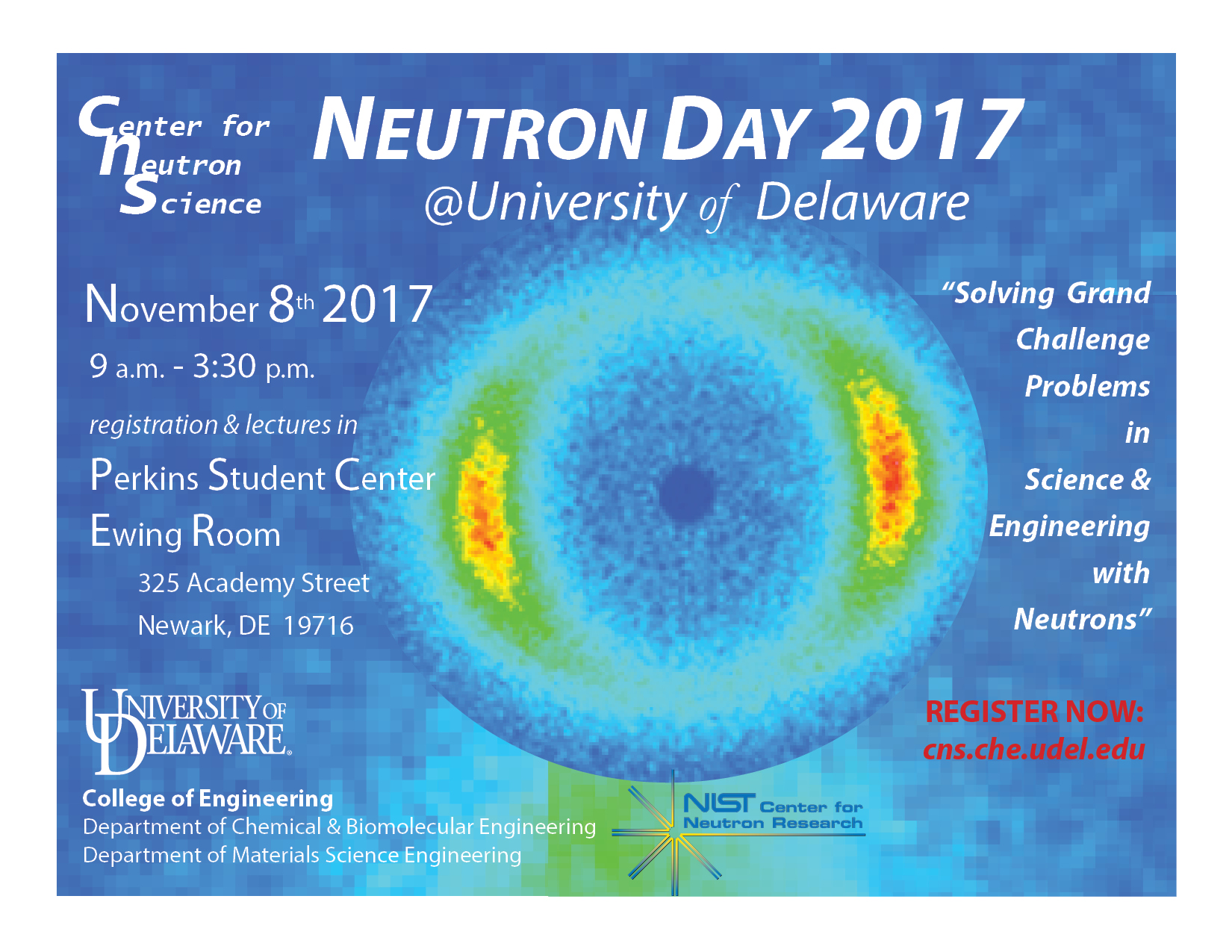
Neutron Day 2017 at Perkins Student Center, Ewing Room on November 8, 2017 from 9:00 a.m. – 3:30 p.m.
2017 Neutron Day Program, Parking Map & Building Locations: Click Here
Poster Presentation List: Click Here
Sponsored by the Center for Neutron Science
NIST Center for Neutron Research (NIST-NCNR)
University of Delaware College of Engineering
Department of Chemical & Biomolecular Engineering
Department of Materials Science & Engineering.
Executive Summary
We propose a cooperative agreement between the Center for Neutron Science (CNS) at the University of Delaware (UD) and the NCNR to focus on advancing neutron scattering metrology through the use of SANS, VSANS, Neutron Reflectometry and NSE for research addressing grand challenges in the areas of sustainable energy, human health, nanomaterials as well as engineering the tools of scientific discovery. The goals of this cooperative agreement include the promotion and development of the use of neutron scattering science by scientists at the NCNR, NIST and the broader community in science and engineering, including macromolecular, colloid, and condensed matter science and chemistry. The seven faculty, nine NIST staff and 12 doctoral students and postdocs currently or proposed to be funded by the CNS have significant, collective experience using neutron scattering in research, and in the design, development, maintenance and optimization of neutron scattering instrumentation. The PI (Wagner) has directed the CNS at UD for a decade, is a fellow of the Neutron Scattering Society of America, was elected to the National Academy of Engineering and the National Academy of Inventors, is a regular user of the NCNR and contributes to NCNR activities and the development of neutron scattering instrumentation world-wide. Collectively, the faculty have trained over 100 doctoral students and postdoctoral scientists in neutron scattering science and have an extensive scientific publication record with high visibility, as also evidenced through many professional awards, and numerous plenary and keynote invited lectures. Many UD doctoral students are or have been in residence at the NCNR for a significant fraction of their doctoral dissertation, which stems from strong, existing collaborations with NCNR scientists, including many co-publications. At least three UD students and postdocs have recently gone on to become NRC postdoctoral fellows at the NCNR. n-SOFT research staff and industrially supported postdocs at the NCNR in collaboration with n-SOFT are a consequence of UD CNS research. The UD CNS has trained generations of undergraduate, graduate and postdoctoral students in neutron scattering methods at the NCNR, and many continue using these facilities as part of their current careers in academia and industry.
The nine, staff to be supported under this cooperative agreement have distinguished accomplishments at the NCNR, making significant contributions to the NCNR’s new data acquisition software (NICE), the development of VSANS, as well as significant scientific advances in soft matter using NCNR resources. The beamline scientists will support the SANS, USANS, VSANS and reflectometry instruments. The beamline scientist Dr. Yun Liu is also a Research Associate Professor at UD and as such, serves as the primary thesis advisor and as co-advisor for a number doctoral students, lectures on neutron scattering at UD and other Universities, as well as teaches at the NCNR summer school. The computer scientists and engineers support NICE and the computational infrastructure of the NCNR more broadly. The mechanical design and draftsman and research scientists are integral to the design, construction, and commissioning of the new VSANS instrument (planned 2018). This proposal also includes a novel collaboration with NCNR staff to develop new interfacial rheology-neutron reflectometry sample environment that will be made available to the broader scientific user community.
The UD faculty, beamline staff scientists, graduate students and postdocs are uniquely qualified to conduct the proposed research activities and to provide excellent research assistance to U.S. neutron researchers using the NCNR. The new sample environments and data analysis methods developed in this proposed work will be made available to promote neutron scattering science more broadly through the NCNR. The close proximity of UD to NCNR, extensive track record of collaborative research, publication, and teaching jointly between NCNR and UD scientists and students greatly facilitate the strong integration of the staff into the activities of the NCNR as described in the management plan. UD is also providing special, dedicated human resources to support the UD/NCNR staff, who can effectively meet the employment needs of the proposed staff. UD students, postdocs and faculty will be in residence at the NCNR during the course of this project and will contribute to the education and support of U.S. researchers using NCNR facilities. This includes expanding our K-12 activities by providing more and improved learning modules for high school science teachers through UD’s Learning Library, which were developed by UD CNS students to educate high school students in the basics of neutron scattering and its uses. CNS faculty also offer a popular graduate course in Scattering Methods in Soft Matter that will be regularly offered during the execution of this cooperative agreement, and also hosts the highly regarded biannual “Neutron Day”, which is a regional celebration of neutron science. Importantly, UD graduates educated in neutron scattering methods and science have gone on to employment at NCNR and NIST more broadly, such that this talented pool of doctoral students and postdocs to be supported under this cooperative agreement are a source of expertise for future staffing.
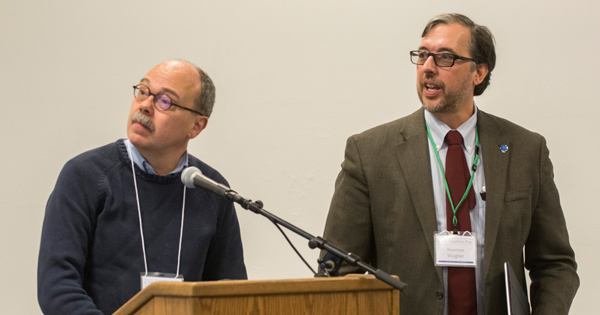
NormWagnerNeutron3: Dan Neumann and Norm Wagner stand at the lectern in the Ewing Room of Perkins Hall on Neutron Day.
The day began with coffee, bagels, and some hearty discussions about experimental data. The University of Delaware’s fifth Neutron Day was held Wednesday, Nov. 8 in Perkins Hall and the Patrick Harker Interdisciplinary Science and Engineering (ISE) Lab. This year, Neutron Day was a celebration of more than its namesake subatomic particle. UD’s Center for Neutron Science (founded in 2007) recently entered into another cooperative agreement with the National Institute of Standards and Technology (NIST) Center for Neutron Research (NCNR). Under this new agreement, UD’s Center for Neutron Science will advance the field of neutron scattering by developing new techniques, applying these techniques to new applications, and training the next generation of neutron scientists. The agreement began on Sept. 1 with $1.7 million of funding and projects a funding total of more than $8.7 million through Aug. 31, 2022, which brings the total funding to the center to well over $30 million over the past ten years. UD’s Center for Neutron Science is directed by Norm Wagner, the Unidel Robert L. Pigford Chair in Chemical and Biomolecular Engineering. He is a fellow of the Neutron Scattering Society of America, a regular user of NCNR facilities and a contributor to the development of neutron scattering instrumentation.
NASA EPSCoR Stimuli Highlight 2016-2017: Melisssa Gordon and Prof. Norman Wagner of the University of Delaware, and Willie Williams, NASA, Johnson Space Center
University of Delaware/NASA Johnson Space Center, Human Exploration & Operations and Space Technology Mission Directorates
As NASA propels science, technology and exploration forward, the need for spacesuits composed of lightweight, long-lived and flexible materials becomes increasingly urgent. In space, micrometeorites and orbital debris (MMOD) can compromise the air barrier of a space suit, causing pinhole punctures that are difficult to identify and repair. Our work focuses on developing healing materials capable of regenerating functionality after damage. In our approach, we are synthesizing fundamentally new, self-healing polymers in which a dynamic bond is built into the network architecture to enable a lightactivated secondary polymerization, increasing the modulus by two orders of magnitude and strengthening the network by over 100%. This work has been recently published in Advanced Materials (2015, 27, 8007–8010). We demonstrated that the material can be completely severed and then remended with increased material strength and no visible scarring. Moreover, our approach confines healing and strengthening to the damaged area; thus, an EVA suit could maintain flexibility in unaffected areas. By developing healing polymer networks, the safety and service lifetime of the material are enhanced. This material was selected by NASA to be tested on the exterior of the International Space Station in 2017 to test its response the extreme environment of outer space. See article…
Stimuli is a summary collection of college and university basic research and technology development reports impacting NASA’s earth science, aviation, and human and robotic deep space exploration programs. This document addresses research which is relevant to NASA’s mission, and currently administered by the agency’s Experimental Program to Stimulate Competitive Research.

Colin D. Cwalina, Charles M. McCutcheon, Richard D. Dombrowski, Norman J. Wagner
The low-earth orbit environment contains small micrometeoroid and orbital debris (MMOD) particles traveling at characteristic velocities of several kilometers per second. In addition to being a direct threat to astronauts and spacecraft, upon impact with the exterior surface of a space vehicle, these highly energetic MMOD particles can create cut and puncture hazards for astronauts performing extra-vehicular activities (EVA). In this work, we demonstrate that replacing the standard neoprene-coated nylon absorber layers with woven aramid textiles intercalated with colloidal shear thickening fluids, i.e., STF-Armor™, can provide a meaningful enhancement to the cut and puncture resistance of the thermal micrometeoroid garment (TMG). Quasi-static puncture testing is performed using hypodermic needles of varying gauge to simulate the cutting and puncture hazards at deformation rates characteristic of human motion. At equal areal densities, we find that a TMG lay-up containing STF-Armor™ greatly improves puncture protection with a reduction in weight and comparable flexibility.
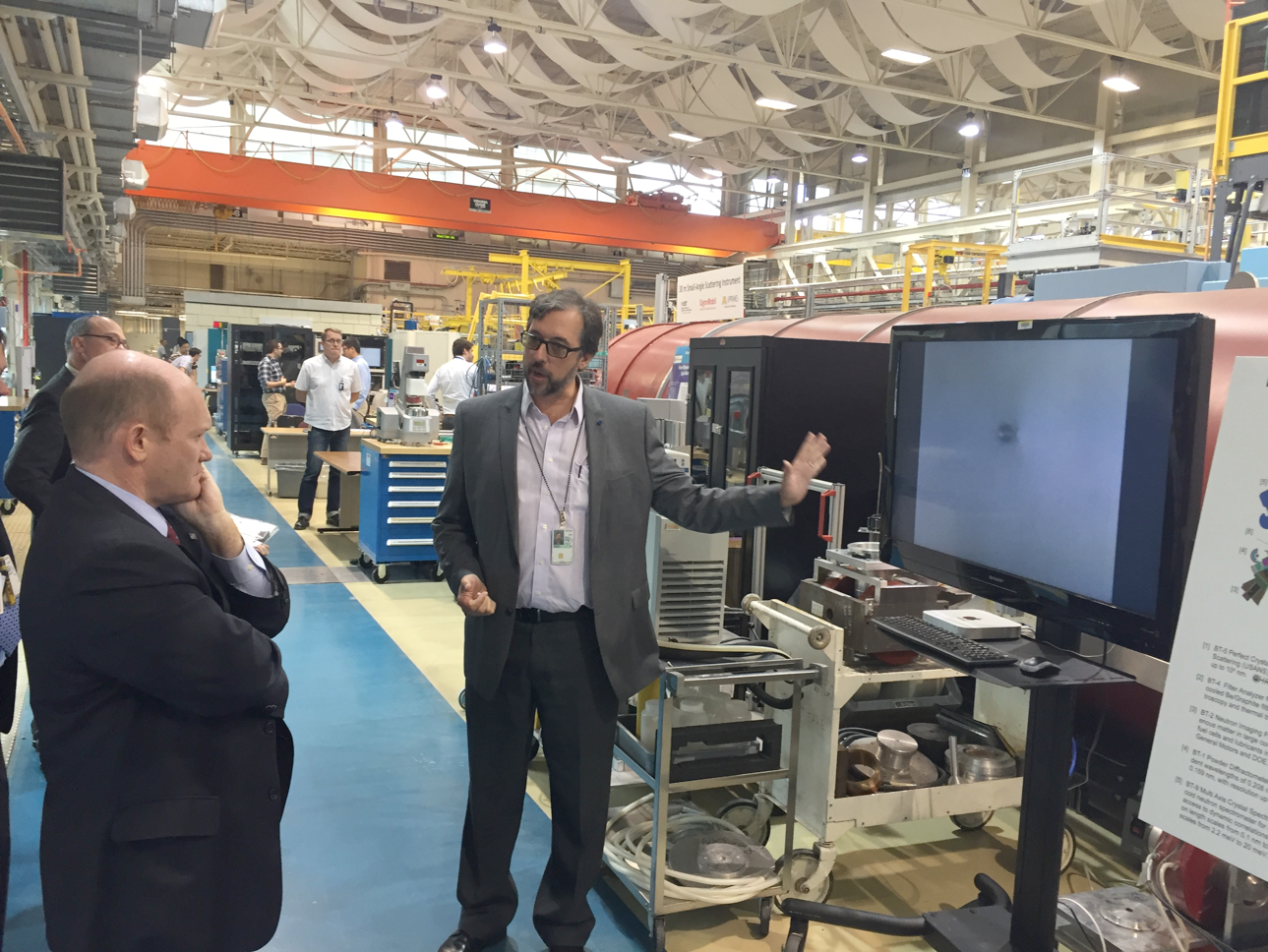
US Senator Chris Coons and Professor Norm Wagner at NIST-NCNR
Read more about the National Institute of Standards and Technology Center for Neutron Research (NIST-NCNR)

Dr Jeff Richards, NIST/UD NRC Postdoc, Ms. Julie Hipp, UD Grad student, and Dr. John Riley, UD, CNS Postdoc, perform some of the world’s first simultaneous rheo-SANS-dielectric measurements on NG7 beamline at the NCNR.

2016 American Conference on Neutron Scattering Queen Mary in Long Beach, California
Four awards were presented to UD and former UD students and faculty at the 2016 American Conference on Neutron Scattering on the Queen Mary in Long Beach CA in July. [From left to right in picture] Prof. Norman Wagner received the Neutron Scattering Society of America’s Service Award for his work on the executive committee and long-standing efforts to raise funding for students, post docs, and young scientists to attend the meeting. Ph.D. student, Michelle Calabrese of the Department of Chemical and Biomolecular Engineering, won one of four student poster prizes out of a field of over 80 scientific posters for her work on understanding the effects of branching on the flow of self-assembled surfactants. Former PhD student, Dr. P. Douglas Godfrin, won the Best Dissertation Award, while Dr. Yun Liu, UD Research Associate Professor and NIST Beamline Scientist won the Science Prize of the ACNS. Dr. Godfrin received his PhD in 2015 for his work on understanding the properties and stability of monoclonal antibodies and protein solutions under the advisement of Prof. Wagner and Dr. Liu. The ACNS is held once every two years and is the premier North American scientific venue for presenting and discussing scientific advances afforded by neutron scattering methods.

Unilever Award is given in recognition of fundamental work in colloid or surfactant science carried out in North America by researchers in the early stages of their careers. The 2016 Unilever Award winner is Prof. Matthew Helgeson from the University of California at Santa Barbara. Matthew E. Helgeson is an Assistant Professor at the University of California, Santa Barbara. In 2004, he received a B.S. degree in Chemical Engineering from Carnegie Mellon University. In 2009, he received his Ph.D. in Chemical Engineering from the University of Delaware, where he performed doctoral research with Norman Wagner and Eric Kaler. From 2009-2012, he performed postdoctoral research in the Novartis-MIT Center for Continuous Manufacturing at the Massachusetts Institute of Technology under the supervision of Patrick Doyle. Helgeson joined the faculty of UCSB in 2012, where he holds an appointment in the Department of Chemical Engineering and is a faculty member of the Materials Research Laboratory. Read more about Helgeson’s research…